KOKUYO
Work, live, learn. Carefully portraying the broad scope of a company that is about far more than stationery.
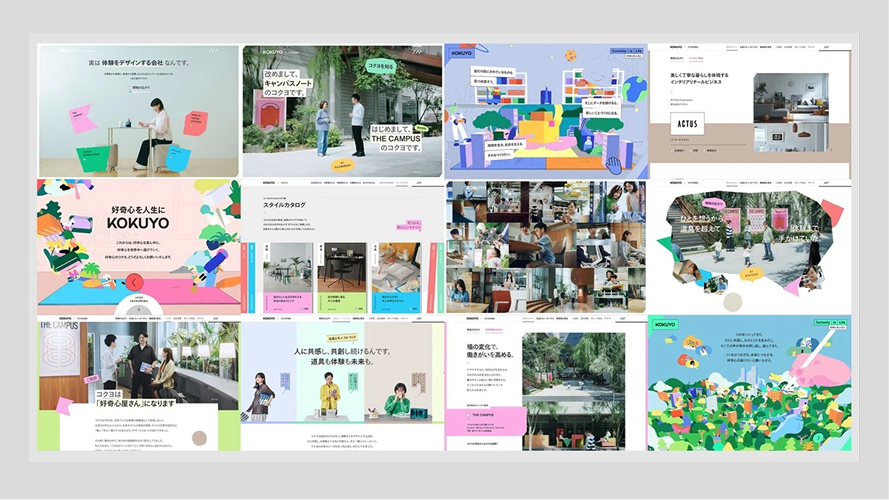
To coincide with the company’s 120th anniversary, we comprehensively edited and carefully built everything — the corporate domain, product sites, portfolio, owned media, and special content — shifting from the image of “KOKUYO, the stationery company” toward its true self: a company that broadly proposes experiences across working, living, and learning. Over roughly two and a half years, we consolidated sites that had been split up by business division into a single site, embodying a new KOKUYO.

目次


About the Client
KOKUYO Co., Ltd.
-
Business
Founded in 1905, KOKUYO designs experiences spanning stationery, furniture, spatial design, and mail-order retail — extending all the way to proposals for how we work, live, and learn.
-
Features
Since its founding, KOKUYO has held firmly to a “people-first” philosophy. Its strength lies in continuously creating value that supports creativity and productivity, moving fluidly across products, spaces, and services as the times change.
What the Project Aimed For

KOKUYO, the stationery company. Contrary to that common image, the businesses and initiatives KOKUYO actually undertakes are far more diverse and wide-ranging. Yet, owing to the legacy of past spin-offs, its sites were divided by business, leaving them hard to grasp across domains. Corporate information, products, and owned media each existed independently, and we were conscious of the problem that visitors found it hard to understand “what kind of company KOKUYO really is.” At the very moment of the 120th anniversary, rather than showing off that history, we needed to shift toward a future-oriented message — “why it has endured” and “what it aims for next” — and to create a direction for expressing the true face of KOKUYO.
Project Timeline
Duration: 2 years 6 months (April 2023 – October 2025)


Point 1 — Setting Direction Through Thorough Research Across 120 Years
Brand Research
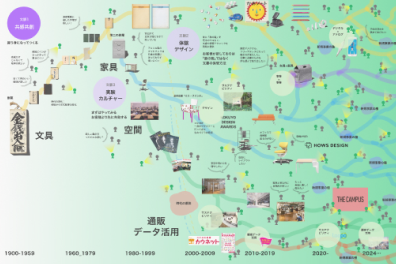
Researching 120 years of materials and interviewing about 25 employees
The starting point of the project was “understanding KOKUYO correctly.” Precisely because this is a company that has expanded its business over 120 years, we felt that surface-level organization of information would never reach the essence, so we began with thorough research. Starting from grasping the structure of the current website, we read through the integrated report, the 100-year history, and the catalogs and booklets of each business, organizing the information across domains. In parallel, we conducted interviews with about 25 people — executives, division heads, and frontline staff. By carefully listening to the background of each business, the context behind decisions, and the values cherished on the ground, a three-dimensional image of the KOKUYO organization gradually came into view.

Direction Setting
Depicting a KOKUYO that connects past and future — toward a 389-page direction-setting document
Through the process, a shared value of “placing people at the center” emerged. Using it as the axis, we organized and edited the contexts of history and future, compiling them into a systematic 377-page direction-setting document. This document is at once material for deciding the direction of design and technology and a record of dialogue for re-examining what makes KOKUYO KOKUYO. By carefully organizing the philosophy with which words, visuals, and experience should be woven together, we created a state in which not only the production team but everyone involved could envision the future at the same resolution. As a result, these 377 pages became a document that holds both “a summary of the past” and “a declaration toward the future,” functioning beyond the bounds of a website as a guideline for KOKUYO’s next 120 years.


Point 2 — Crossing Barriers Through Repeated Dialogue: A Hands-On Consensus-Building Process
Project Management
Overcoming complex issues that documents and meetings alone can’t convey — through dialogue repeated again and again
This project had to advance within a structure involving many stakeholders, and there were many moments where considerations grew complex due to differences in opinion and position. For that reason, rather than rushing to conclusions, we placed importance on proceeding while repeating dialogue with stakeholders. Instead of presenting a single overall answer at once, we adopted an approach of organizing the issues that arose at each meeting and presenting the next materials and options for consideration. For gaps in understanding and background that could not be fully shared through documents or chat alone, we aligned through in-person and online meetings. During the project, we worked with multiple regular meetings per week, adding extra meetings as needed. Through this process, we were able to resolve issues one by one and accumulate agreement, which in turn laid the foundation for steadily advancing a complex project.


Point 3 — The Life-Sized KOKUYO Character Revealed Through Dialogue
Information Design
Finding the company’s character in its people, and making it a powerful axis for the site — in editing, photography, and more
In the information-design phase, although the “people-centered” concept had been established, there was the challenge that the “how to say it” aspect of expression remained undecided. The turning point came through dialogue with President Kuroda and employees, carried out in parallel with the medium-term management plan project, where KOKUYO’s character traits — “Kansai dialect,” “approachability,” and “wit” — came into view. With this discovery, it became shared understanding that information design reflects not only structure and copy but the company’s humanity, and from then on it functioned as a consistent guideline extending to site design, photography, and editorial policy.

Point 4 — A Corporate Site as “Experience,” Not Just Mandatory Information
Information Design
Planning content around KOKUYO’s distinctive character
A corporate site carries a great deal of mandatory information — company overview, business introductions, and so on — and is an area where the structure easily becomes formulaic. In this project, too, we proceeded on the premise of first organizing that information and conveying it accurately. At the same time, what came into view as we deliberated was that simply lining up information does not sufficiently convey a company’s character or way of thinking. So, rather than the volume or comprehensiveness of information, we placed importance on “in what order, and from what angle, to show it,” redesigning the overall structure from an editorial perspective. Specifically, with the tone of words and the construction of copy as the axis, we linked photography and layout so that, as you read on, you naturally come to understand the company’s background and breadth. In “Getting to Know KOKUYO” we organized its thinking and history, and in “The Breadth of Its Fields” we made the development of the business graspable step by step — a design that lets you read on according to the depth of information.

Point 5 — Building Product Sites to Convey KOKUYO’s Appeal
Content Design
A perspective for spanning products of different natures
In integrating the different fields of stationery and furniture into a single site, our aim was not simply to standardize information structures and formats. Even though product size, use, and target differ, we focused on the fact that both are “products that support people’s actions and environments,” and searched for an editorial perspective that could run through both consistently. What became the axis as we deliberated were the perspectives of “making things” and “style.” Rather than dividing by product category, by reconstructing information starting from the thinking behind products and the scenes in which they are used, we aimed for a structure that lets you move seamlessly across stationery and furniture. Through this organization, a structure took shape in which you can follow individual product information while understanding the entire product range as a single flow.


Expressive methods to convey product appeal intuitively
What we commonly valued in product-area expression was the sensory exhilaration of arriving at the site. The appeal of stationery and furniture comes through by encountering new products, picking them up, and trying them. So we were conscious of bringing the site close to the feeling of stepping into a stationery shop or a furniture store. Specifically, we created a showcase-like structure where the noteworthy products of the moment can be lined up, designed so that the person in charge can create highlights from a VMD perspective. For uses and functions that still images alone cannot fully convey, we incorporated video and stop-motion, complementing the sense of understanding through touch. While avoiding excessive direction, through choices of color and motion we layered expression that naturally conveys each product’s individuality and approachability. Through this accumulation, we built a product area where you face products by seeing and feeling them, rather than products lined up merely as information.

Point 6 — Building an Owned Media Run by Employees Themselves as Editors
Owned Media Operation
The challenge of how to reorganize owned media scattered across 22 outlets
On KOKUYO’s website before the renewal, individual communications were carried out by department and product, and there were roughly 22 owned-media outlets for reading content alone. While there were many high-quality articles and initiatives, the dispersion of these channels made information hard for users to reach, and the overall picture of “what KOKUYO is communicating” was hard to see. For some projects and services, communication was insufficient, and there were not a few cases where their very existence was unknown. In response, we thought what was needed was not to increase the number of individual outlets but to bundle the scattered voices once and organize and reconstruct them from the perspective of “communication as KOKUYO.”
Building a magazine area stocked with 39 articles at launch
What we proposed was the launch of a new “magazine area.” By consolidating the reading content that had been published in various places, we aimed to strengthen communication while creating a new acquisition channel from an SEO standpoint. Beyond external communication, by also serving as an internal newsletter, it is positioned as a place that leads to inner branding and the cultivation of employee awareness. In the planning and article-production phase, the editorial professionals at itskn joined, and we proceeded with production in collaboration with KOKUYO. At the launch on October 2, 2025, we published 39 articles in total — 10 produced by itskn and 29 by KOKUYO. Being able to start with wide-ranging content while incorporating internal and external expertise is also a feature of this initiative.

Voices from the Makers
-
Yonemichi
-
“There’s no job that never ends.” That’s what the KOKUYO team said in the hard moments. It turned out to be true. Please do go and see the site we built together with the client. Congratulations on the 120th anniversary!
-
Umetsu
-
In this season of the autumn equinox, how are you all keeping? I’m doing well. A project of this scale is hard to pull off, I don’t want to do it again, and I won’t! Being able to write a line like this is thanks to everyone involved. That’s all — thank you kindly.
Articles About This Site

タグ