2026.11.12
Whether it’s a website redesign or brand development,
it all starts with the approach.
Project Design at mount
You want to redesign your website. You want to rethink your brand.
The redesign is a go, but you’re not sure where to start.
That’s where we start: working with you to decide A Rough Outline of the Process before anything is made. This is what we call Project Design.
Contents
What do you do in project design?
Project Design is the work of deciding, before a website redesign or brand-building project begins, what to take on, in what order, who to partner with, and what the next step will cost, then bringing it all together into a single path forward. In short, it is about A job that involves establishing a “working draft of the process” before starting production.
After listening to you and assessing where things stand, we map out what needs to be decided, and in what order, before moving on to requirements definition or brand strategy. We don’t always proceed exactly as requested. We consider what will be most effective for your business, and when necessary, we rethink the request itself. If we believe it’s better to work in phases rather than all at once, we’ll propose that sequence too.
Not a single design has been made yet. Instead, by the end, you’ll have a clear picture of what to do next.
What will you have in hand once Project Design is complete?
There are two things we always deliver, both compiled into a single document.
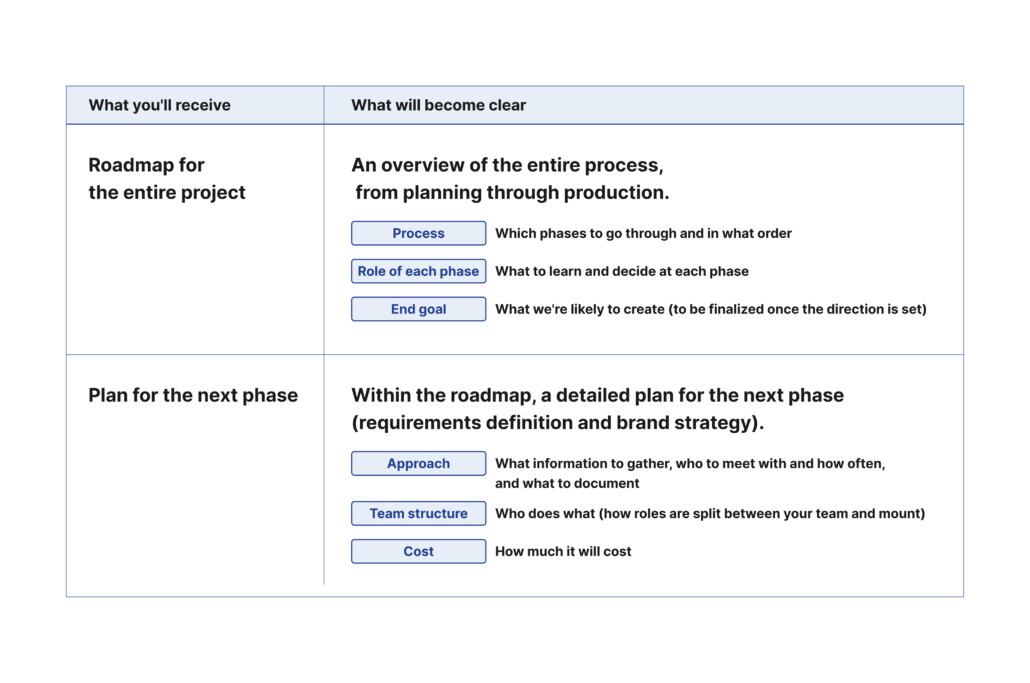
Depending on the project, past Project Design work has also included the following:
Customer touchpoint map:
How the places where you meet your customers, such as websites, apps, social media, and physical stores, connect to one another, both as they are now and as they should be.
A Preliminary Analysis of the Current Situation:
What your current website, printed materials, videos, and other media communicate, what they don’t, and why.
Issue mapping:
What the current issues are, and where to start.
General Budget Allocation:
Estimated costs for each initiative, and the order in which to invest.
What does Project Design make possible?
You can put your budget and time into what really needs to be done.
Rather than carrying out the request as is, we first identify what will be most effective for your business, then set the order and allocation. This cuts down on detours, such as starting on a whim and changing direction later.
You can take the next step straight to internal approval.
Because the approach, team, and costs for the next phase are laid out in advance, you can submit them directly for internal approval.
You can explain the reasoning within your organization.
With a roadmap, you can show executives where things stand and what comes next. Internal team members and outside partners can all work from the same map.
You can hand things over, even when people change.
The results of the discussions remain as documents, not just in someone’s head.
Case study: How did we proceed with KOKUYO?
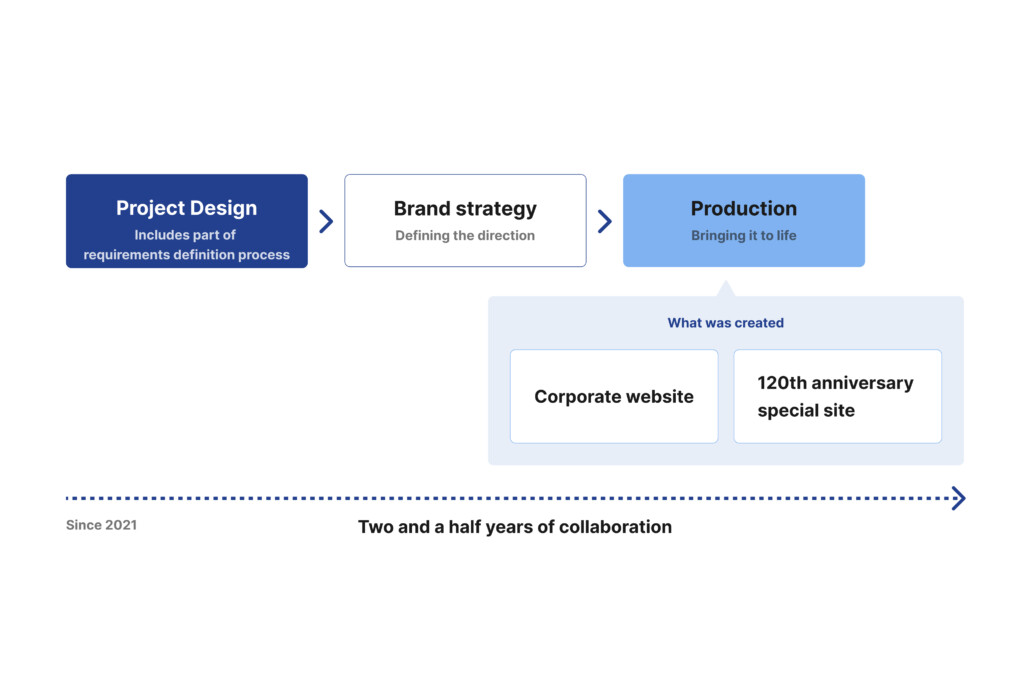
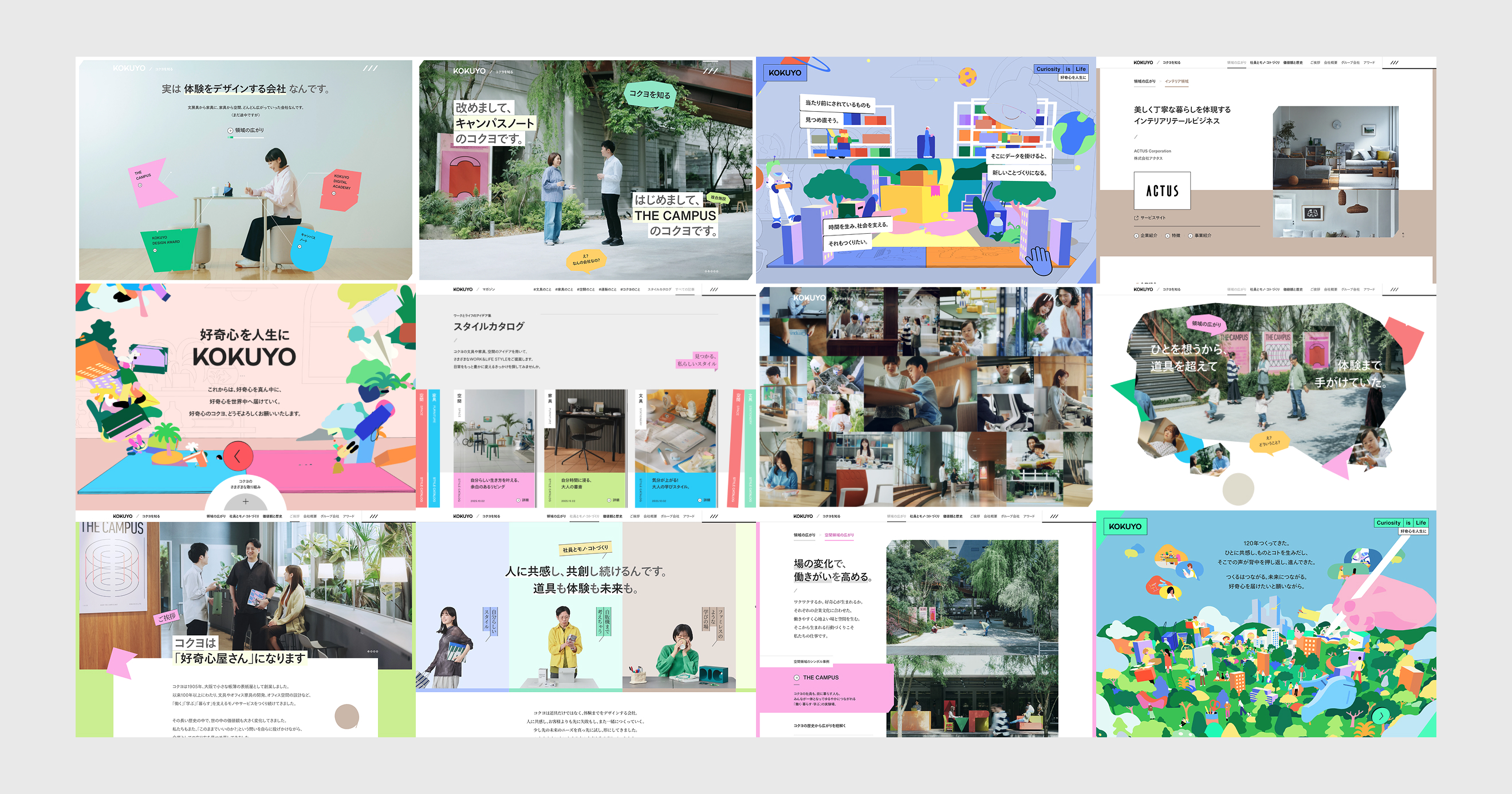
Over two and a half years starting in 2021, we worked with KOKUYO through Project Design, brand strategy, and production, creating its corporate website and a special site for its 120th anniversary. The initial Project Design, which also covered part of the requirements definition, set out the following:
▪What the site needed to communicate
▪Issues with the current site and communications
▪A draft direction for the site
▪A draft page structure
To identify the issues, we conducted an expert usability review (heuristic analysis), analyzed visitor data (web analytics), and compared the site with competitors in the same industry. We first determined what needed to be communicated, then examined the issues in light of it. Everything was still at the draft stage, but by sketching out the framework in this order, we were able to set a clear direction through brand strategy before moving into production.
Because the overall path was mapped out from the start, requests that might have seemed separate could be built up step by step as one continuous plan.
When will we know the production cost or the total budget?
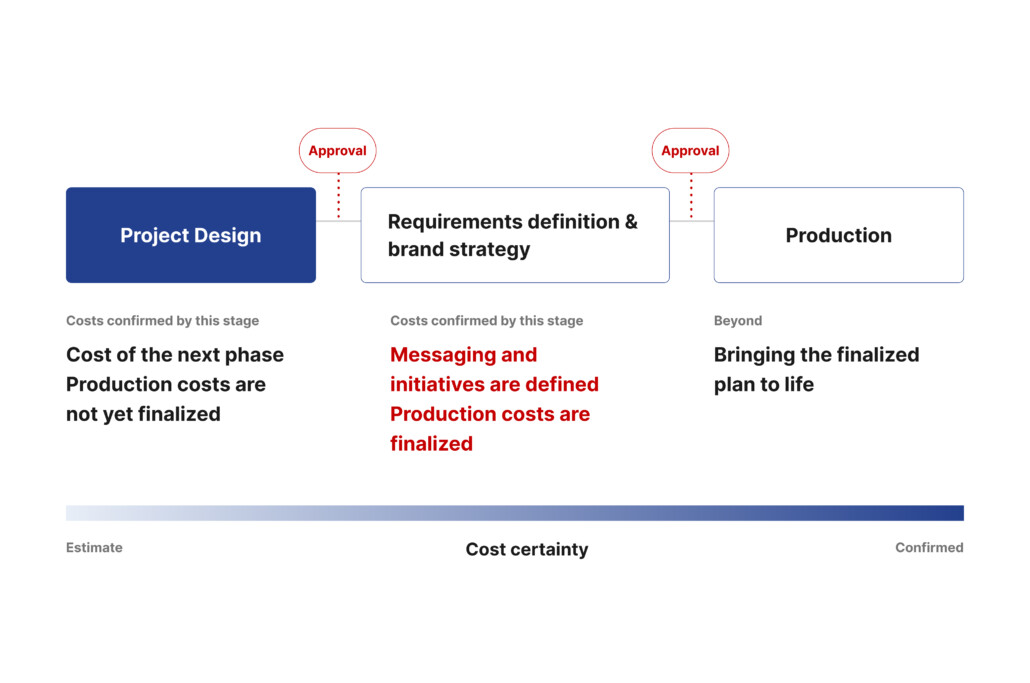
At the Project Design stage, what you’ll know is the cost of the next phase: requirements definition and brand strategy.
Production costs are finalized once the scope has been set through brand strategy. A production budget can only be grounded in evidence once it’s clear what will be made, because the workload becomes predictable only after what to communicate, and what to create, have been decided. This means you can explain internally that only the cost of the next step needs approval for now, and that the overall budget will be confirmed stage by stage.
There’s no need to set a budget that includes production before the full picture is clear. You can review the details at each stage and decide whether to move forward once you’re satisfied.
The cost of Project Design itself consists of four components: producing, research, design, and project management. Research stands on its own because listening closely and understanding deeply are where our work begins. The workload and timeline vary with the scale of the project. In our experience, it typically takes about one to two and a half months, including time for your internal review.
Frequently asked questions about Project Design
⸻ ⸻ How is it different from requirements definition?
Project Design comes before requirements definition. It is where we decide what needs to be decided, and in what order. Once the approach is set and you’ve approved it, we move on to requirements definition and brand strategy.
⸻ ⸻ Can we commission Project Design only?
Yes. We deliver the roadmap and approach in a form you can use whoever you work with afterward. That said, we’d ideally like to stay with you through production. What we heard, what we researched, and the understanding we built during Project Design can all be carried directly into making. We want to see the path we drew at the start through to its final form.
⸻ ⸻ We’ve already identified our issues internally. Do we still need it?
If the issues are already identified, things move faster. In Project Design, we take those issues as our starting point and build an approach while confirming that they can actually be addressed through production. The role of this work is to put the issues into an order in which they can be solved.
⸻ ⸻ Is it okay to start with a small request?
Of course. Our work with AFURI BREWING began with a request for a single logo. Through ongoing conversations, it has grown to cover their communications as a whole, including the website. Even if the starting point is small, we can step back into Project Design when needed and start again from the big picture.
⸻ ⸻ Can it be used for projects other than websites?
Yes. Project Design isn’t limited to websites. We look across everything a project needs, from logos and visual identity to brand books, films, and packaging, decide how to proceed, and carry it all the way through production.

What happens before we design shapes what we design
Taking time to think before making — that is how we work at mount.
What should be done, and why? We confirm this together with our clients before we start making. We believe that time is what ultimately determines the quality of the finished work. Project Design is also a way of setting that time aside from the beginning.
You don’t need to have everything figured out from the start. Maybe nothing has been decided yet. Maybe you don’t know where to begin. That’s a perfectly fine place to start. Let’s begin by sketching out the rough big picture together.


