2025.10.17
[KOKUYO Vol.5] What we pursued was the quality and optimization of WebGL: KOKUYO’s “big picture” and “curiosity” packed into a pop-up notebook
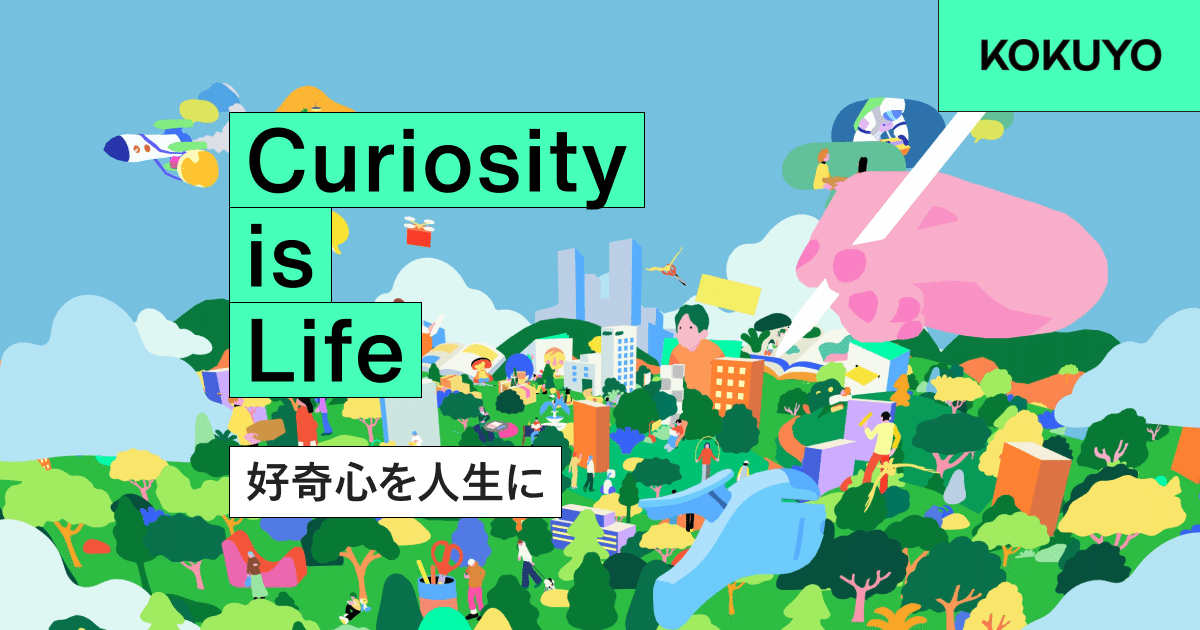
“Curiosity is Life.” This is the new corporate message KOKUYO set out on reaching its 120th year since founding. To deliver KOKUYO’s world view — full of hope and packed with excitement — as an interactive user experience on the web, we pursued the quality of WebGL and the optimization of its performance. In Vol.5, “The Special Content,” we look back on the behind-the-scenes of how we expressed KOKUYO’s message as an experience on the web. First, please experience the content itself before reading the article.
*Viewing on a PC is recommended.
▼Related articles
・Vol.1: The Full Picture of the Project
・Vol.2: The Corporate Site
・Vol.3: The Product Site
・Vol.4: The Magazine Area
Contents
1. Devising the idea and concept
Two things we wanted to express in the Special Content
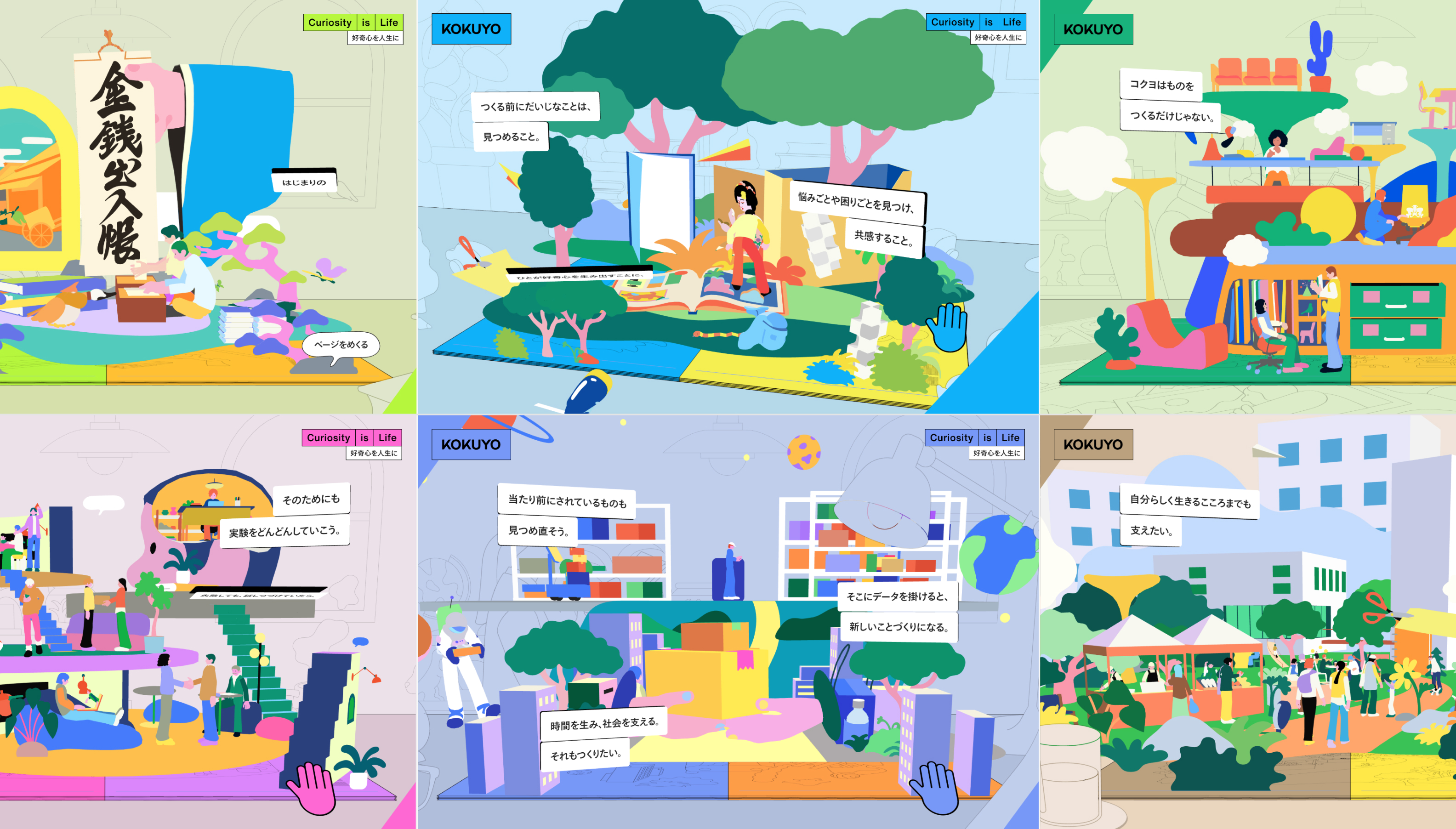
Every time you turn a page of the notebook, KOKUYO’s “things” and “happenings” pop up one after another.
An exciting world unfolds. This Special Content was planned not merely as a flashy promotion to commemorate the 120th anniversary, but to express the very philosophy that connects KOKUYO’s past, present, and future itself.
CD/AD Yonemichi puts it this way:
“There were clearly two things we wanted to express in the Special Content:
the big picture of the conceptual diagram, and the message ‘Curiosity is Life.’” The “conceptual diagram” is the figure, defined in the early strategy stage, that gives a bird’s-eye view of “What is KOKUYO?”, shown below.


In the corporate, product, and magazine areas, we had been able to express each individual spot, but the one thing we had not been able to express was the whole feel of the conceptual diagram.
There was no place that could show KOKUYO’s big picture as an experience.
And then there was “Curiosity is Life,” which is also KOKUYO’s corporate message. How to translate these into the content was the crux at the planning stage.
Curiosity popping out of a Campus notebook
More than 20 ideas were considered at the concept-planning and design stage. Among them, the motif we ultimately chose was the “Campus notebook,” and the prototype of the concept was a “pop-up picture book.”
Ideas written in a notebook become three-dimensional, pop out, and blend into people and society —.
This was a metaphor for what KOKUYO has done for 120 years — “thinking of people, giving form to ideas, and delivering them to society as things and happenings; these bring curiosity to people and form a rich society” — a concept that could hold true only for KOKUYO.
-
Designer Ide
-
Story development and illustration ran in parallel. By hand, I drew more than 60 roughs per set and verified the motion on the principle of a flip-book. I used these for presentations, too. The aim was to unify the team’s understanding by concretely showing how objects would pop out and move. It was truly painstaking work.
The world you see by looking through curiosity
Once the “pop-up picture book” concept was set, the question was how to translate the theme of “curiosity” into an experience within the content.
What emerged in that discussion was the idea that “if you put on something like AI glasses, what is drawn in the notebook appears to pop out in three dimensions.”
The notion of a “filter” connecting the real world and the world where excitement takes shape developed into the concept of switching worlds via the 594-degree “diagonal line” of KOKUYO’s new visual identity.

-
TD Umetsu
-
The idea that “wouldn’t it be fine for the original real world (the flat plane of the notebook) to remain visible behind the realized world?” gave rise to a multilayered expression in which both worlds coexist.
2. Each production phase
Copywriting that determines the content’s narrative
The copywriting was handled by Gen Kogusuri.
Based on an enormous amount of input — KOKUYO’s 120-year history, its vision for the future, employee interviews, and more — he wove the narrative.
The story is structured to trace “past, present, future.” Seven sections — ledgers, stationery, furniture, space, mail-order, THE CAMPUS, and KOKUYO’s future — lead into a greeting for the 121st year.
-
CD/AD Yonemichi
-
“The most important policy in the copywriting was to make you feel why KOKUYO speaks of curiosity, without directly saying ‘Curiosity is Life.’ If you read the story, I think you’ll understand that KOKUYO has earned the right to speak of ‘curiosity.’”
Varied illustrations expressing a sense of excitement
The illustration was handled by Ayumi Takahashi. She drew hundreds of objects with a KOKUYO-like “sense of excitement” and “vividness of color.”
Dynamic, unique CG animation
The CG animation was handled by everyone at MORIE Inc. Conveying the image of the motion, centered on Yonemichi and Ide, they added movement to the illustrations. Through close collaboration during implementation as well, we were able to build the world just as we had imagined it.
Music that brings a sense of excitement to the experience
The music was handled by Ryo Arimura.
Adopting the idea of changing the track for each of the seven sections, he produced eight pieces in total. Rather than a single background track, sounds are added and the atmosphere shifts as the story progresses, expressing how the experience grows richer.
-
CD/AD Yonemichi
-
We asked for sound-making with a human touch. Rather than electronic sounds, Arimura emphasized the sound of live instruments, ambient sound, the sound of tools, and human voices, creating sound with a sense of “texture.”
3. Painstaking adjustments made across job boundaries
In the 3D production, the designer’s role was expanded as well.
Designer Ide looks back as follows:
“We asked MORIE Inc. for the 3D production from the illustration-rough stage.
Using Blender, I placed the flat illustration assets within 3D space. When placing flat illustrations into 3D space, fine adjustments were needed for parts where the perspective became unnatural, and to raise the sense of density.
The sheer volume was considerable — about 500 objects placed throughout — and I redid it many times over.”
Beyond such fine adjustments, Ide took on production beyond a designer’s domain — animating flat objects in Blender, editing JSON files directly, and more.
4. The technical challenges we faced
Behind the scenes of the Special Content lay any number of technical challenges. To deliver the experience of an interactive pop-up notebook, we introduce what we did to reconcile the quality of expression with performance.
Page-turning and performance optimization
At first, pursuing physical accuracy, TD Umetsu implemented it with physics simulation using many (100–200) calculation points. But because this method involved an enormous amount of computation, performance issues remained. So he rethought the approach and generated a “Bézier surface” producing a smooth curved surface from 16 control points. This achieved a lightweight, natural page turn.
Moving 3D models that follow the notebook’s curvature
What TD Umetsu calls the most technically difficult was “linking the 3D models with the page” — making the animated 3D models placed on top of the page follow it in real time, in step with the page-turning motion. Verifying whether it was even technically feasible alone took about two weeks.
The 3D models placed on the notebook (birds, figures, and so on) are made up of many small triangles and are constantly animating. In step with the page-turning motion, we needed to obtain all the vertex coordinates of these moving 3D models and make them follow the page’s deformation.
After various verifications, we finally succeeded in making them follow. This realized the most impressive experience in this content — products and people continuing to move vividly even while a page is being turned.
Seamless synchronization of the background music
We built a system in which the music switches smoothly, without interruption, in step with page transitions. Overcoming both a high-load method aiming for perfect synchronization and the latency issues of simple playback, we discovered and implemented an intermediate method that reconciles performance and quality.
Specifically, we tested the following three approaches and adopted the third, which had the lowest load.
1. Perfect synchronization
A method that fully syncs at the MP3 frame level (on the order of 0.001 sec). Extremely accurate, but its load on performance was very high and caused crashes on older smartphones, so it was abandoned.
2. Simple playback
A method that simply plays the next track. Easy, but a gap arose at the switch between tracks and harmed the experience, so it was not adopted.
3. An intermediate of 1 and 2.
Preload the next background track data and keep it on standby, “ready to play at any time.” When a page is turned, obtain the elapsed time of the previous track (for example, 10:00) and start the next track from that time.
For method 3, because there is no time spent searching for the playback position, the latency is small. Strictly speaking, a gap of a fraction of a second may occur, but it is at a level humans cannot perceive — an optimal solution that reconciles performance and quality.
5. The team’s close cooperation and coordination drove the project forward
Handling a large amount of 3D data and complex computation, this content was constantly dogged by performance issues. Improving them demanded swift responses from every member.
Sensing the danger that tasks like asset compression and on-device checks were concentrating on the engineers and becoming a bottleneck, developer Terada sought ways to make designer–engineer collaboration stronger and smoother. By introducing tools that make the work easy even for non-engineers, she pursued a streamlining of the workflow that went beyond just solving technical problems.
Specifically, on the designers’ working PCs she introduced automatic compression/conversion scripts using Node.js and a local server using a VS Code extension. This let even non-engineers prepare assets themselves and check the website’s display directly on their own PCs, achieving a major reduction in time.
-
TD Umetsu
-
Late in the project, performance problems grew serious, and we even considered cutting many 3D models. In the end, though, by thoroughly carrying out painstaking compression work — centered on D Ide and Dev Terada — we managed to reach release without greatly compromising the look.
Please don’t turn the pages roughly; handle them gently (laughs).
Overcoming any number of difficulties, we released it safely on the memorable day of KOKUYO’s 120th anniversary.
Delivering the experience to many people.
We received many responses — voices saying their children were engrossed in it, and voices of surprise from overseas.
6. In closing
The behind-the-scenes of the KOKUYO site build, delivered across all five installments.
What is written here is only a small part of it.
The project’s path held more difficulties than words can capture, and the learnings and realizations gained from them.
Below are the credits for the production members who took part in this web-renewal project. It was precisely because of each individual’s strength that we could see this great challenge through to the end. Had even one person been missing, it would not have taken its current form.
And above all, to everyone at KOKUYO, who faced the production team sincerely and chased the ideal shape of craft together with us.
Thank you truly.
As one of the makers, I feel fortunate to have been able to take part in this project. Let me take this opportunity to once again thank everyone who was involved.

▼The proposal document (377 pp.) is available for a limited time!
Answer a few quick questions to download it!
https://forms.gle/q2ozygdNbB9uQJm19
▼For work inquiries or consultations with mount, clickhere
▼Past articles
・Vol.1: The Full Picture of the Project
・Vol.2: The Corporate Site
・Vol.3: The Product Site
・Vol.4: The Magazine Area
October 17, 2025 — Interview and text: Yuriko Horie (mount inc.)
* This article used AI to help with the translation.