2026.10.14
What It Means to Build a Website with AI Today.
Behind the Scenes of Implementing Animations for
Monex, Inc.'s Introductory Site.

Members
Writer
Kenji Okabe
TD
Introduction
I’d like to put into words, in my own way, what it means to build a website using AI.
I’m sure many creators experience the emotional ups and downs of working with AI on a daily basis. I’m no exception, and I often find myself wrestling with mixed feelings about it.
But after implementing almost the entire character animation system with AI, I’ve started to see things a little more positively.
To put it simply: it was fun.
When I say “fun,” some people might think, “How can you be so laid-back about client work?”
But that’s not quite what I mean. It’s not about feeling excited or having fun in the usual sense. It’s about becoming so absorbed in the work that, before you know it, you’ve pushed past the tedious and difficult parts. Looking back, you might realize that the time you spent so immersed in the work was, in its own way, “fun.”
The more deeply you engage with the work, the further you can take it. And that depth of engagement is closely tied to enjoyment.
So why did I feel this way while working with AI, when I never expected to? That’s what this article explores.
What Did We Make?
A WebGL-based 2D character rigging tool.
We built a variety of custom features specifically for this site and character.
*Rigging is the process of setting up a skeletal structure for an illustration, making it easier to create natural-looking motion.
How Did We Approach It?
As the design took shape, I felt the key was making this illustration move as vividly as possible. So we started exploring different approaches.
(The work below is by Suda.)
1. AI-Generated Video (Kling AI)
Maybe we just lacked the skills, but I couldn’t see how we could do it better.
*This was created as part of the testing process and is not related to the actual character.
2. 3D / Toon Shading
We decided not to pursue this approach because perfectly recreating the illustration’s look and feel in 3D seemed too difficult.
3. Live2D
This seemed like a possibility in terms of the movement we were aiming for.

Why Did We Build Our Own Tool?
We needed to animate an illustration designed as a still image, rather than one created specifically for animation. So we eventually decided it would be better to build a tool from scratch instead of relying on an existing library.
Normally, rigging is done using a “T-pose,” with the character’s arms extended horizontally. In our case, we needed to add motion to an illustration that was already posed, like the one below. The crossed legs also made it difficult to use as a typical rigging asset. The character also faced sideways by default, with no front-facing version, which was another unusual constraint.

Don’t Let AI Take Control
Here’s how I think about working with AI.
First of all, AI will never produce the final output I envision in a single shot.
There are two reasons why I can say that with absolute certainty.
1. Because it’s impossible to fully describe what I have in mind to AI.
2. Because the ideal emerges and evolves through the process of creating it.
If I ask AI to make something, it can produce a result that feels impressive. It may even be better than what I originally had in mind. But ultimately, it’s a collection of ideas from elsewhere, shaped by others, so it can never be exactly what I envisioned. (Regardless of whether it’s good or bad.)
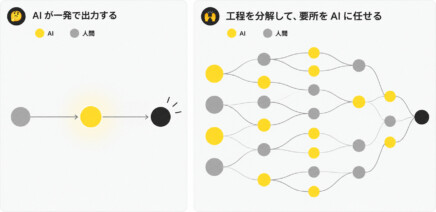
That’s why I’ve made a conscious decision not to hand over control to AI.
I start by breaking down the process and deciding which parts should be handled by AI and which by humans.
The overall approach hasn’t changed much from the pre-AI era; certain parts of the process have simply been shortened with AI.
Even if more of the work is delegated to AI, I want humans to stay in control of the bigger picture.
When a large chunk of the work is given at once, it’s easy to think, “Well, I guess that’s good enough,” even when small details bother you. Over time, that can lead to something that doesn’t feel quite right.
More than anything, I’m afraid of ending up with something I can’t explain to others. Even before AI, I wanted to be someone who could stand on their own in the real world.
This is almost the opposite of the often-heard advice to “build a loop,” and I don’t claim it’s the right answer.
I also want to avoid simply falling back on familiar methods.
To resist AI’s gravitational pull toward homogenization, I believe thinking for myself and making my own decisions are things I shouldn’t compromise on.
(Even if I get a little discouraged sometimes…)
A Fully AI-Driven Human × A Non-AI Human
What I proposed to the team was that we make this a project where two very different kinds of human could work together to see it through, and in the process, find our own way of working with AI.
For direction and interaction, we divided the work so that AI-generated components were assembled by humans, who then worked to create harmony across the overall experience.
・Okabe = Fully AI-driven human (character system)
・Suda = Non-AI human (overall interaction)
When it comes to 2D rigging, AI has an overwhelming advantage over building the system from scratch by hand.
On the other hand, humans are still faster and more precise at creating a seamless user experience based on timelines, scrolling, tapping, and dragging.
*Yamashita also explored a different approach, finding a balance between human and AI involvement. I’d like to have her talk about that separately.
Implementing the Tool
Although the tool was built almost entirely with AI, we planned it in detail beforehand and gave AI thorough instructions, using diagrams like the one above.
In the end, about 80% of the output matched what we intended. From there, we fine-tuned it repeatedly while using the tool.
There’s something satisfying about an AI that responds well to clear instructions.
In the past, I would often run out of energy building a tool and ask another team member to handle the actual implementation. This time, I was able to see the whole process through on my own.
I also wanted to find out what I could and couldn’t delegate to AI.

One thing I learned was that Photoshop work—breaking the illustration down for the tool and drawing in additional details—was the part I could least delegate to AI. I had to do it myself.

One key finding was that the Photoshop work involved in breaking down illustrations into tool-compatible components and drawing in missing details was the hardest part to delegate to AI. In the end, this work had to be done manually.
As long as the desired outcome cannot be clearly articulated or quantified, this kind of task remains difficult for AI to handle reliably, at least for now.
The Feeling of “Actually Making Something”
There’s a theory that “AI will take away the joy of making things.”
I’ve been affected by this idea myself. But surprisingly, this project gave me a genuine sense of “actually making something.”
Of course, it’s different from the satisfaction of writing code from scratch and seeing it take shape.
Still, it was somewhat reassuring.
Coming up with an idea → Designing it → Implementing it
Parts of this process may be replaced by AI, but the overall approach remains the same. I realized that the act of “making” itself hasn’t changed. This may partly be because I was never particularly inclined to be a craftsman-like programmer in the first place. Still, it was encouraging to see that there is plenty of room for creativity and ingenuity in the process.
Conclusion
Throughout the implementation, one question kept coming back to me:
“Who could actually do this?”
I kept going back and forth between “Anyone can do it” (99%) and “I’m the only one who can do it” (1%).
With AI, many people could create something similar. But it’s still incredibly tedious, and specialized knowledge and experience matter. Most importantly, the idea of what to make and how to make it must come from me.
“Websites can just be generated by AI. Anyone can make one.”
It’s understandable that people would say that, and I can’t change their minds. But I don’t have to see it that way myself.
As long as the result varies depending on who makes it, I don’t feel ready to say, “Then I don’t need to do it.”
With a little stubbornness, perhaps.


